Every morning before anything else.
The sheets.
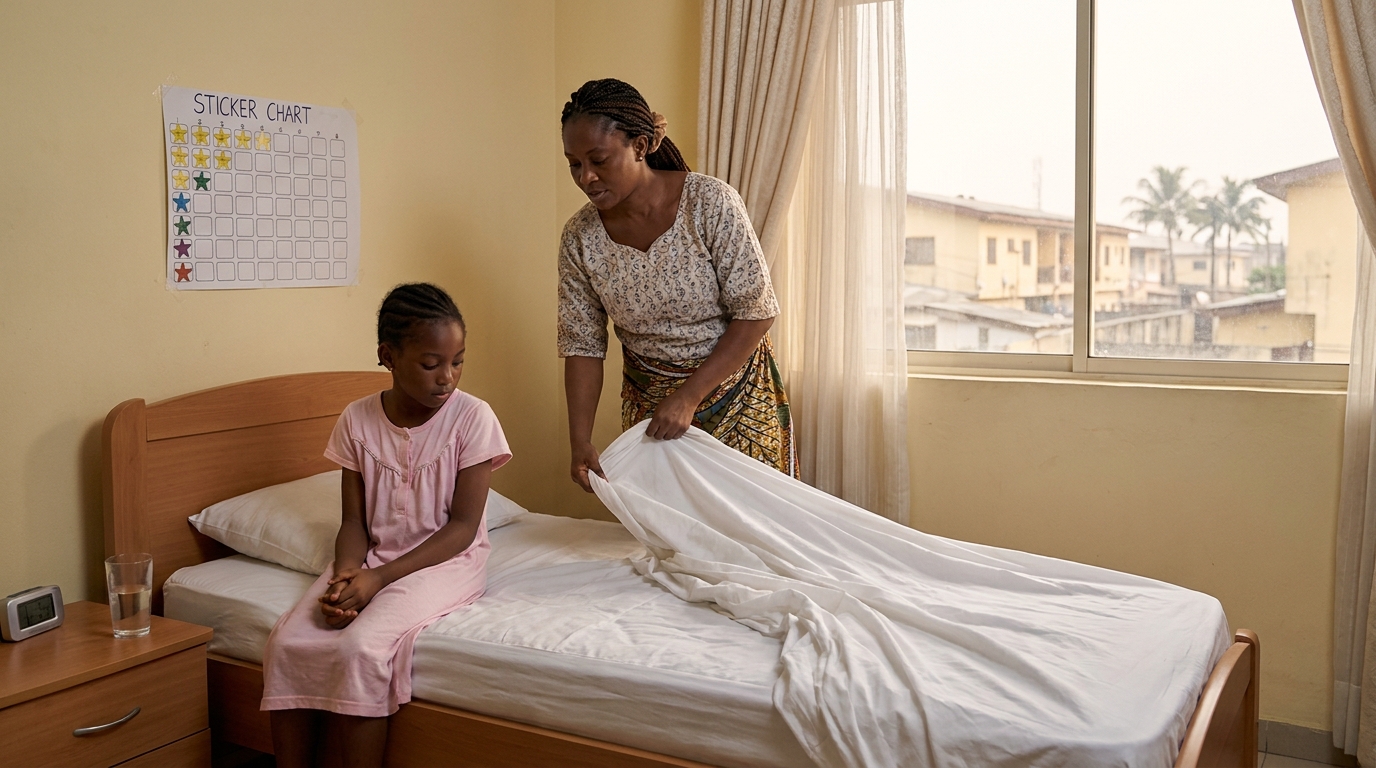
You know before you open her door. You've known since 5am, when the small shift in the bed sounds told you it had happened again. You open the door with the quiet resignation of a mother who has stripped these sheets so many times she no longer needs to think about where the clean ones are.
The sheets go into the washing machine. She goes into the bathroom. Neither of you speaks about it. You've learned not to speak about it. The speaking never helped anything. It made her cry. It made you feel like you'd done something wrong just by noticing. So now you strip the sheets in silence and she knows you've done it and you both move through the morning pretending that the pile of wet linen in the machine doesn't exist.
She is 9 years old. She has been wetting the bed since she was 6. Three years of wet sheets every morning. Three years of waterproof mattress covers. Three years of her declining every sleepover invitation from her friends because the thought of waking up wet in someone else's house is too shameful to risk. Three years of you watching your daughter shrink her social life around a secret she carries alone.
And 100% of children with this condition feel nervous most of the time, according to research published on Nigerian children with enuresis. 87.3% of Nigerian caregivers describe it as a source of shame. 23.8% of affected Nigerian children are bullied by peers. Your daughter is one of millions of Nigerian children living under the weight of a condition that has a solution — and nobody told you what it is.
If the sheets are wet again this morning, if your child has declined sleepovers because the shame is too great, if you've tried limiting water and midnight waking and market herbs and nothing has worked, if a doctor told you "she'll grow out of it" with no timeline and no plan, keep reading.
My name is Ngozi. I'm 38. I live in Lagos. I'm a civil servant.

And for 3 years, the sheets were the first thing I dealt with every morning. Until a 71-year-old retired community health worker named Mama Chidinma showed me what every strategy I'd tried had in common: they managed the symptom without addressing the cause.
The Birthday Sleepover She Didn't Attend
June 2026. Adaeze's best friend Chisom was turning 10. Birthday sleepover. Six girls. Chisom had been planning it for weeks. She invited Adaeze first, because they are best friends. Adaeze said yes immediately.
Three days before the sleepover, Adaeze came to me in the kitchen. Her face was the face of a child carrying something heavy.
"Mummy. I don't want to go to Chisom's sleepover anymore."
"Why? You were excited."
"I just don't want to go."
I knew. I knew exactly why. She didn't have to say the word. The word was the same word that stripped the sheets every morning. The same word that bought the waterproof mattress covers. The same word that made a 9-year-old girl tell her best friend she didn't want to come to her birthday party.
She called Chisom and made an excuse. Chisom was disappointed. Adaeze was quiet for the whole of Saturday, the day of the sleepover she wasn't at.
That evening I sat on her bed — the bed with the waterproof cover, the bed she was ashamed of, the bed that woke me every morning to strip sheets in silence — and I made a decision. My daughter will not decline another invitation because of this. Whatever it takes, whatever it costs, she will sleep at her friend's house without fear. I will find what nobody has told me yet.
Three Years of Strategies That Managed Without Fixing
Limiting water after 6pm. The first advice from every source: restrict fluids before bedtime. We tried this for 4 months. Adaeze went to school thirsty. Her teacher noticed she wasn't drinking during school hours. And the bedwetting continued — because, as I later learned, nocturnal enuresis in children her age is primarily a sleep arousal problem, not a volume problem. The bladder signals but the sleeping brain doesn't wake to respond. Less water in does not teach the brain to wake. ₦0 cost. 4 months of a thirsty child. Zero improvement.
Midnight waking. Every night at midnight, I set my alarm, got up, and woke Adaeze to use the toilet. She was confused, groggy, resentful of being disturbed. Some nights she used the toilet and the bed was still wet by morning because the bladder filled again before 6am. Other nights she resisted so strongly I gave up. After 2 months, I was exhausted and Adaeze's sleep quality was poor. Her teacher reported she was unfocused in class. The midnight waking was disrupting two people's sleep without resolving the bed's condition. Abandoned.
Market herbal preparations. Two separate sellers. First: ₦4,000. "Children's bedwetting mixture." Adaeze took it for 3 weeks. No change. Second: ₦6,500 from a different market in Surulere. "Guaranteed to stop bedwetting in 10 days." 14 days later, the sheets were still wet. ₦10,500 on mixtures that guaranteed results they could not deliver.
Pediatric consultation. ₦15,000. I described the problem. The pediatrician said: "Nocturnal enuresis in a 9-year-old is common. In most cases, children grow out of it. Limit fluids in the evening and try waking her at midnight." The two strategies I had already tried for months, presented as if they were new. When I said we had already tried them, she said: "Give it more time. Most children resolve by 10." Adaeze was 8 at the time. ₦15,000 for advice I had already failed with, and a 12-month waiting instruction.
Bed alarms. I researched online and found bedwetting alarms. A sensor that wets with moisture and wakes the child. I ordered one from a Lagos electronics seller for ₦12,000. First night: the alarm went off, Adaeze woke up confused and crying, the sheets were soaked because the alarm triggered AFTER the accident rather than preventing it. The alarm is designed to train the brain to wake BEFORE the bladder releases — but this requires weeks of consistent use and a child who is not a deep sleeper. Adaeze sleeps deeply. The alarm disrupted her sleep for 3 weeks without producing improvement. Abandoned.
Total in 3 years: over ₦42,000. Fluid restriction that dehydrated a child without helping the bed. Midnight waking that exhausted two people. Market herbs that guaranteed nothing. A pediatrician who repeated the failed advice. A ₦12,000 alarm that alarmed but did not train. And the sheets, wet again every morning, stripped in silence.
The Elder Who Understood Why the Bed Was Still Wet
July 2026. A visit to my mother's compound in Anambra. Extended family gathering. My mother's neighbour, Mama Chidinma. 71 years old. A retired community health worker who had spent 40 years in Anambra communities and had spent the last decade helping families manage childhood bedwetting using a structured approach she had developed across hundreds of cases.
I mentioned Adaeze's situation quietly, as one mentions something shameful. Mama Chidinma listened without judgment.
"Tell me about her sleep," she said. Not 'tell me about the bedwetting.' Tell me about her sleep."
I described it. Adaeze sleeps deeply. Very deeply. She is difficult to wake. She sleeps through sounds that would disturb others. When I woke her at midnight, she was disoriented.
"That is the condition," Mama Chidinma said. "Not the bladder. The sleep. The bladder signals correctly — it fills, it reaches capacity, it sends the signal to wake up. But Adaeze's brain does not respond to that signal during deep sleep. The signal goes unheard. The bladder releases because the brain gave it no instruction to wait."
"Every strategy you have tried treats the bladder. Restrict water: less in the bladder. Wake at midnight: empty the bladder manually. Market herbs: claim to strengthen the bladder. Alarm: alert the brain after the bladder releases. None of them teach the brain to WAKE when the bladder signals. The brain is the problem. The brain is what must be trained."
She had developed a 3-part approach over years of working with Nigerian families:
Part 1: The Brain-Bladder Connection Training. A structured daily programme that strengthens the neural pathway between bladder fullness and sleep arousal. Not midnight waking (which empties the bladder but doesn't train the brain). A specific sequence of daytime exercises that build the brain's sensitivity to bladder signals during sleep — the same pathway that resolves bedwetting in children who "grow out of it" naturally, but accelerated through structured practice.
Part 2: The Bladder Capacity Builder. Most children who bedwet have a functionally smaller bladder capacity — not anatomically smaller, but behaviourally undertrained. Specific daytime exercises that progressively extend the bladder's holding capacity and strengthen the detrusor muscle's ability to maintain control through longer periods. Research consistently shows that bladder training exercises reduce bedwetting episodes in children who complete them consistently.
Part 3: The Evening Support Protocol. Specific timing, food adjustments, and preparation practices in the 3 hours before bed that support the brain-bladder connection and reduce the depth of sleep at the critical early-morning hours when most bedwetting occurs. Not fluid restriction. A structured evening protocol that works with the body's natural rhythm rather than against it.
"21 days of consistent practice," she said. "The brain-bladder connection doesn't form overnight. It builds daily. By Day 7, most children begin waking before the accident — not reliably, but occasionally. By Day 14, the waking becomes more frequent. By Day 21, most children are waking consistently or the bladder is holding through the night. Some children take 28-35 days for the full connection to form, but the trajectory is clear by Day 21."
Days 1-6: The Sheets Were Still Wet
We started the Monday after returning from Anambra. Brain-bladder training daily. Bladder capacity exercises. Evening protocol every night.
Day 3: wet sheets. Day 5: wet sheets. Day 6: Adaeze looked at me at breakfast with the expression of a child who has been promised something and is beginning to doubt it.
"Mummy, it's not working."
"It's working underneath, baby. You can't see it yet. But it's building."
Mama Chidinma's voice in my head: "The brain-bladder connection takes 7-10 days to begin showing surface signs. The training is happening below the surface — neural pathways forming that have never existed before. The first sign is not a dry night. The first sign is a child waking up during the night. Not necessarily making it to the toilet. Just waking. The brain is learning to receive the signal. Waking is the first evidence."
Day 7: I heard Adaeze's feet on the floor at 3am. She went to the bathroom. I held my breath. She came back to bed. The sheets were dry in the morning.
The first dry morning in 3 years.
Day 21: She Asked About the Next Sleepover
By Day 14, dry nights and wet nights were roughly equal — an extraordinary shift from wet every night.
By Day 21, Adaeze had experienced 5 consecutive dry nights. The longest streak since the bedwetting began at age 6.
On Day 21, she came to me at breakfast with the expression of a child who has been carrying something heavy and has set it down.
"Mummy. When is Chisom having her next party?"
I looked at her. She looked at me.
"I think I can go now," she said.
My 9-year-old daughter, who had declined her best friend's birthday sleepover 6 weeks earlier because the shame of waking up wet in someone else's house was too great to risk, was asking about the next sleepover. Not whether she could go. WHEN.
She went to a sleepover at Chisom's house in August. Stayed the whole night. Came home in the morning with the face of a child who has reclaimed something that was taken from her. Dry. Happy. Normal. A 9-year-old who slept at her friend's house without fear.
What Changed Beyond the Bed
The sheets. I strip them once a week now, for normal washing. The waterproof cover is still on the mattress but it has been dry for weeks. The pile of wet linen that used to greet me at 6am every morning is gone. The silent morning ritual is over.
Adaeze. Her teacher mentioned — unprompted — that her focus had improved. Research confirms that bedwetting disrupts children's sleep quality and affects academic performance and concentration. The dry nights are giving her better sleep. Better sleep is giving her a better day. She is a different child in class.
The social life. She has been invited to two more gatherings since Chisom's sleepover. She said yes to both. The parent who asked me at the second one: "Adaeze is so confident. She's always happy." She is. Because the thing she was carrying is gone.
I Wasn't the Only One
My sister-in-law in Enugu. Son, 11. Bedwetting for 5 years. "Ngozi, the bladder capacity builder was what changed everything. My son's bladder was holding far less than it should at his age. The daytime exercises increased his capacity over 3 weeks. By Day 21, he was sleeping through. By Day 28, we removed the waterproof cover. The sheets have been dry for 2 months."
My neighbour in Surulere. Daughter, 10. "We tried the alarm for 6 weeks. It disrupted her sleep and mine and changed nothing. The brain-bladder connection training in this method is what the alarm is trying to achieve — but the alarm does it reactively (after the accident) and this method does it proactively (training the brain to receive the signal before the release). Night and day difference."
Same method. Different children. Ages 7 to 12. Different causes. Same result: the brain learns to receive the bladder signal during sleep, the child wakes or holds through the night, the sheets are dry, and the child who was too ashamed to sleep at a friend's house is asking when the next sleepover is.
Why I'm Sharing This
After Adaeze's recovery, I asked Mama Chidinma's permission to document her method. "Mama, there are children in Nigeria declining sleepovers. Parents stripping wet sheets in silence every morning. Families spending money on market herbs that guarantee what they cannot deliver. Children being bullied. Parents being told 'she'll grow out of it' with no timeline and no plan. Can I write this down?"
She agreed. "Tell them: the problem is not the bladder. The problem is the brain-bladder connection that never fully developed, or developed late. Train the connection and the bedwetting resolves. Tell them also: this is not the child's fault. And it is not the parent's failure. It is a developmental variation that responds to structured training. The child is not lazy. The child is not being difficult. The brain simply never learned to wake up."
The Old Dry-Nights Secret
Mama Chidinma's Method for Ending Bedwetting in Children Ages 6-12
The brain learns. The bladder holds. The sheets stay dry. The child reclaims their childhood.

What Other Parents Are Saying
"4 years. ₦50,000 spent. Midnight waking, market herbs, a pediatrician who said 'give it time,' and a bedwetting alarm that alarmed without training. The brain-bladder connection training was what nothing else had attempted: teaching the sleeping brain to WAKE. By Day 10, my son was waking himself at 2am. By Day 21, he was sleeping through dry. He told me last week: 'Daddy, can I go to Uncle Tobi's house this weekend?' First time he's asked to sleep out in 4 years."
"The bladder capacity builder changed everything. My daughter's bladder was holding very small volumes — she was making 8-10 bathroom trips daily, which I hadn't connected to the bedwetting. The daytime exercises increased her capacity over 3 weeks. When the bladder can hold more during the day, it holds more at night. By Day 18, first dry morning. By Day 25, 6 consecutive dry nights. The connection between daytime capacity and night-time control is something no pediatrician had mentioned."
"6 years. My son is 12. The shame was destroying him — he refused to attend youth church camp 2 years in a row. By Day 21 of this method, 4 consecutive dry nights. By Day 35, he had not wet in 2 weeks. He went to youth camp this July. Stayed 5 nights. Came home and told me: 'Mummy, I slept fine.' I held him in the kitchen and cried. 6 years. 35 days to end them."
"My daughter is 7. The school began sending home concerns that she was distracted and sleepy in class — the disrupted sleep from bedwetting and the anxiety were affecting her during the day. By Day 14 of the method, she had her first dry week. Her teacher sent home a note: 'Chidinma seems so much more focused and happy this week.' The dry nights gave her the rest she needed. The rest gave her the school day she deserved."
"My mother called it spiritual. My neighbour said to rub palm oil on the mattress. My church said to pray more. My pediatrician said to wait. None of them understood that this is a developmental condition with a structured solution. Mama Chidinma's method gave us the structure. Day 21: first dry morning. Day 28: waterproof cover removed. Day 35: my son asked his cousin to come for a sleepover at OUR house. He was the host. Something he could never have been before."
"My daughter was being teased at school — somehow her classmates found out. Research I've since read confirms 23.8% of Nigerian children with bedwetting are bullied. The shame was layered: the teasing at school, the restriction at home, the declining of invitations, the feeling that something was wrong with her. The method gave her dry nights. The dry nights gave her back her confidence. By Day 28, she told her teacher she wanted to enter the school debate competition. The child who was hiding is stepping forward."
Main Method: ₦20,000 value
Bonus #1 (21-Day Dry-Night Protocol): ₦8,000
Bonus #2 (Bladder Training Food Guide): ₦8,000
Total Value
₦36,000
You Pay Today
₦9,800
One payment. Lifetime access. Works for ages 6-12. Day by day for 21 days.
Instant download • Both guides included • 14-day guarantee • Works ages 6-12
Plus: 2 Essential Guides
🌙 BONUS #1: The 21-Day Dry-Night Protocol
(₦8,000 Value. Yours FREE)

A day-by-day structured calendar for the full 21-day method. Each day specifies the brain-bladder training exercise (duration, technique), the bladder capacity exercise (timing, progression), and the evening protocol steps. Colour-coded by week. Progress tracking column. Designed so the child can participate in marking their own progress — turning the method into something they own, not something done to them. Print it and put it on the bedroom wall.
🌙 BONUS #2: The Bladder Training Food Guide
(₦8,000 Value. Yours FREE)

Specific foods and drinks that increase bladder irritability and worsen nocturnal enuresis (including some children consume daily without parents knowing). Foods that support bladder muscle tone and sleep quality. The correct fluid timing schedule — NOT fluid restriction, but the specific timing of water intake across the day that supports bladder capacity training and reduces night-time production. Common Nigerian foods and drinks assessed individually.
14-Day Unconditional Guarantee
Start the method. If you are not satisfied for any reason within 14 days, full refund. No questions asked.
You keep both guides regardless.
The sheets stay dry or you pay nothing.
Right Now, You Have a Choice
Another wet morning in silence.
Another invitation declined because the shame is too great.
Another pediatrician visit with advice you've already tried.
Another market herb that guarantees what it cannot deliver.
The brain-bladder connection does not form on its own in children whose development has taken this pattern. "Growing out of it" happens — but on an unpredictable timeline that could be months or years. Meanwhile, your child is shrinking their life around a secret they carry alone.
Imagine 21 days from now:
You open her door in the morning. The sheets are dry.
She asks about the next sleepover. You say yes.
The waterproof cover comes off the mattress.
The child who was hiding steps forward.
₦9,800. 21 days of structured practice. The brain learns to wake. The bladder learns to hold. The sheets stay dry. Your child's childhood is fully returned to them.
P.S. #1: What will the sheets look like tomorrow morning? The same as today? ₦9,800 and 21 days of structured practice stand between tomorrow's wet sheets and the morning your child wakes up dry and asks about the next sleepover.
P.S. #2: You've spent money on market herbs that guaranteed results (₦10,500 in our case). On a pediatric consultation that gave you the same advice you'd already tried (₦15,000). On a bedwetting alarm that alarmed without training (₦12,000). ₦37,500 on management. ₦9,800 on the method that addresses what caused the problem. The brain-bladder connection. The one thing nobody tried to fix.
P.S. #3: Research on Nigerian children with nocturnal enuresis confirms that 100% of affected children feel nervous most of the time, and 23.8% are bullied by peers. Your child is carrying this alone. The child who declined the sleepover, who sits out the school trips, who keeps the secret even from their best friend — they are waiting for this problem to end. 21 days. The brain learns. The secret ends.